President Clinton Was Impeached by the House of Representatives for
| Impeachment trial of Neb Clinton | |
|---|---|
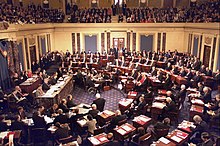 Senate in session during the impeachment trial | |
| Accused | Bill Clinton, President of the United States |
| Date | Jan vii – February nine, 1999 (1 calendar month and 2 days) |
| Outcome | Acquitted by the U.S. Senate, remained in office |
| Charges |
|
| Cause | Clinton's testimony denying that he had engaged in a sexual relationship with Monica Lewinsky in a sexual harassment lawsuit filed against Clinton past Paula Jones; allegations made in the Starr Report |
The impeachment trial of Neb Clinton, the 42nd president of the United States, began in the U.South. Senate on Jan 7, 1999, and concluded with his acquittal on February ix. Later an inquiry between October and Dec 1998, President Clinton was impeached by the U.South. House of Representatives on Dec 19, 1998; the manufactures of impeachment charged him with perjury and obstruction of justice. Information technology was the second impeachment trial of a U.S. president, preceded past that of Andrew Johnson.
Background [edit]
Under the U.S. Constitution, the House has the sole ability of impeachment (Article I, Section two, Clause 5), and after that activeness has been taken, the Senate has the sole power to hold the trial for all impeachments (Article I, Section iii, Clause 6). Clinton was the 2nd U.S. president to face a Senate impeachment trial, later Andrew Johnson.[1]
An impeachment inquiry was opened into Clinton on October eight, 1998. He was formally impeached by the House on two charges (perjury and obstruction of justice) on Dec 19, 1998.[2] The specific charges against Clinton were lying nether oath and obstruction of justice. These charges stemmed from a sexual harassment lawsuit filed against Clinton by Paula Jones and from Clinton's testimony denying that he had engaged in a sexual relationship with White House intern Monica Lewinsky. The goad for the president'southward impeachment was the Starr Report, a September 1998 written report prepared by Contained Counsel Ken Starr for the Firm Judiciary Commission.[three]
Planning for the trial [edit]
Betwixt December 20 and January 5, Republican and Democratic Senate leaders negotiated about the pending trial.[iv] There was some discussion about the possibility of censuring Clinton instead of holding a trial.[iv] Disagreement arose as to whether to phone call witnesses. This decision would ultimately not exist made until later on the opening arguments from the House impeachment managers and the White House defense team.[4] On January 5, Majority Leader Trent Lott, a Republican, announced that the trial would start on January 7.[4]
Officers of the trial [edit]
Presiding officer [edit]

The Chief Justice of the U.s. is cited in Article I, Department 3, Clausehalf-dozen of the United states Constitution as the presiding officer in an impeachment trial of the President.[5] As such, Main Justice William Rehnquist causeless that role.
House managers [edit]
Thirteen House Republicans from the Business firm Judiciary Committee served as "managers", the equivalent of prosecutors.[6] They were designated to be the Firm impeachment managers the same mean solar day that the two articles of impeachment were approved (December 19, 1998).[4] They were named by a House resolution which was approved by a vote of 228–190.[7] [8]
| Party | Vote | ||||
|---|---|---|---|---|---|
| Yeas | Nay | Present | Not voting | ||
| Democratic (206) | v
| 187 | – | 14
| |
| Republican (228) | 223 | 2
| – | 3
| |
| Independent (one) | – | 1
| – | – | |
| Total (435) | 228 | 190 | 0 | 17 | |
| Business firm managers[6] | |||||||
|---|---|---|---|---|---|---|---|
| Chairman of Business firm Judiciary Committee Henry Hyde (Republican, Illinois) | Bob Barr (Republican, Georgia) | Ed Bryant (Republican, Tennessee) | Steve Buyer (Republican, Indiana) | Charles Canady (Republican, Florida) | Chris Cannon (Republican, Utah) | Steve Chabot (Republican, Ohio) | |
| | | | | | | | |
| George Gekas (Republican, Pennsylvania) | Lindsey Graham (Republican, South Carolina) | Asa Hutchinson (Republican, Arkansas) | Bill McCollum (Republican, Florida) | James E. Rogan (Republican, California) | Jim Sensenbrenner (Republican, Wisconsin) | ||
| | | | | | | ||








Clinton'due south counsel [edit]
| President'due south counsel[10] | ||||
|---|---|---|---|---|
| White House Counsel Charles Ruff | Deputy White House Counsel Bruce Lindsey | Deputy White Firm Counsel Cheryl Mills | Special White House Counsel Gregory B. Craig | |
| | | | ||
| Lanny A. Breuer | Dale Bumpers | David Eastward. Kendall | Nicole Seligman | |
| | | |||



Pretrial [edit]
The Senate trial began on January vii, 1999. Chair of the House impeachment managing director team Henry Hyde led a procession of the Firm impeachment managers carrying the articles of impeachment beyond the Capitol Rotunda into the Senate sleeping room, where Hyde then read the articles aloud.[4]
Chief Justice of the United States Supreme Court William Rehnquist, who would preside over the trial, then was escorted into the sleeping accommodation past senators past a bipartisan escort committee consisting of Robert Byrd, Orrin Hatch, Patrick Leahy, Barbara Mikulski, Olympia Snowe, Ted Stevens.[xi] Rehnquist so swore-in the senators.[xi]
On January 8, during a closed-door coming together, the Senate unanimously passed a resolution on rules and procedure for the trial.[4] [12] [13] Yet, senators tabled the question of whether to call witnesses in the trial.[4] The resolution allotted the House impeachment managers and the president's defence force team, each, 24 hours, spread out over several days, to present their cases.[4] It also allotted senators 16 hours to present questions to both the house impeachment managers and the president'south defence force squad. Afterwards this, the senate would be able to hold a vote on whether to dismiss the case or to continue with information technology and call witnesses.[4]
The trial remained in recess while briefs were filed by the House (on January eleven) and Clinton (on January xiii).[fourteen] [15] Additionally, on January 11, Clinton'due south defense force team denied the charges made against Clinton in a thirteen page response to a Senate summons.[4]
On January 13, the same day that his lawyers filed their pretrial brief, Clinton told reporters that he wanted to focus on the business of the nation rather than the trial, remarking, "They have their job to do in the Senate, and I have mine."[4]
Testimony and deliberations [edit]
Impeachment managers' presentation (Jan fourteen–16) [edit]
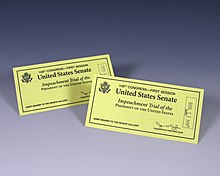
Tickets dated Jan fourteen and 15, 1999, for the impeachment trial
The managers presented their instance over three days, from January xiv to 16,[4] [sixteen] with discussion of the facts and background of the instance; detailed cases for both articles of impeachment (including excerpts from videotaped thou jury testimony that Clinton had made the previous August); matters of interpretation and application of the laws governing perjury and obstruction of justice; and argument that the evidence and precedents justified removal of the President from office by virtue of "willful, premeditated, deliberate corruption of the nation's system of justice through perjury and obstacle of justice".[xvi]
Defense's presentation (January 19–21) [edit]
The defense's presentation took place Jan nineteen–21.[four] [sixteen] Clinton'south defence force counsel argued that Clinton's grand jury testimony had too many inconsistencies to be a clear case of perjury, that the investigation and impeachment had been tainted by partisan political bias, that the President's approval rating of more than 70 percent indicated his ability to govern had not been dumb by the scandal, and that the managers had ultimately presented "an unsubstantiated, circumstantial example that does non meet the constitutional standard to remove the President from office".[16]
Questioning past members of the Senate (January 22–23) [edit]
Jan 22 and 23 were devoted to questions from members of the Senate to the Firm managers and Clinton'southward defense counsel. Nether the rules, all questions (over 150) were to be written down and given to Rehnquist to read to the party being questioned.[4] [17] [18]
House impeachment managers' interview of Monica Lewinsky (January 24) [edit]

On January 24, Monica Lewinsky (pictured) was interviewed past the House impeachment managers
On Jan 23, a judge had ordered Monica Lewinsky (who Clinton had allegedly perjured about a sexual relation with) to cooperate with the House impeachment managers, forcing her to travel from California back to Washington, D.C.[4] On January 24, she submitted to a nearly ii-hour interview with the Business firm impeachment managers, who remarked after the interview that Lewinsky was, "impressive", "personable" and, "would exist a very helpful witness" if called.[four] Lewinsky'south ain lawyers claimed that no new information had been produced in the interview.[4]
Debate and votes on motion to dismiss and movement to call witnesses (Jan 25–27) [edit]
On January 25, Senator Robert Byrd (a Democrat) moved for dismissals of both articles of impeachment.[19] [20] This motion would only require a majority vote to pass.[21] That twenty-four hours, senators heard arguments from the managers confronting dismissal, and from the president's defense team in support of dismissal, before and so deliberating behind closed-doors.[four] [17]
On January 26, House impeachment manager Ed Bryant motioned to call witnesses to the trial, a question the Senate had avoided up to that betoken. He requested depositions from Monica Lewinsky, Clinton's friend Vernon Jordan, and White House aide Sidney Blumenthal.[4] [22] The House impeachment managers presented arguments in favor of allowing witnesses, and then the president'due south legal squad presented arguments against allowing witnesses.[17] Democrat Tom Harkin motioned to append the rules and agree open contend, rather than airtight argue, on the move to allow witnesses. The senators voted 58–41 against Harkin'southward movement, with Democrat Barbara Mikulski being absent due to affliction. The Senate, thus, voted to deliberate on the question in individual session, rather than public, televised process, and such private deliberation was held that day.[23]
On January 27, the Senate voted on both motions in public session; the movement to dismiss failed on a well-nigh party line vote of 56–44, while the motion to depose witnesses passed by the same margin. Russ Feingold was the simply Democrat to vote with Republicans confronting dismissing the charges and in support of deposing witnesses.[4] [24] [25]
Depositions [edit]
Votes on procedures for witnesses (Jan 28) [edit]
On Jan 28, the Senate voted against motions to dismiss the charges confronting Clinton and to suppress videotaped depositions of the witnesses from public release, with Democratic Senator Russ Feingold again voting with Republicans against both motions. Absent from the chamber, and therefore unable to vote, were Republican Wayne Allard and Democrat Barbara Mikulski, the latter of whom was absent-minded due to illness.[26] [27] [28]
Taping of closed-door depositions (Feb 1–3) [edit]
Over 3 days, February one–iii, House managers took videotaped airtight-door depositions from Monica Lewinsky, Vernon Jordan, Sidney Blumenthal. Lewinsky was deposed on February 1, Jordan on February 2, and Blumenthal on February iii.[four] [17] [29]
Motions on presentation of evidence (Feb 4) [edit]
On February four, the Senate voted seventy–30 that excerpting the videotaped depositions would suffice as testimony, rather than calling live witnesses to appear at trial.[4] House impeachment managers had wanted to call Lewinsky to prove in-person.[four]
Showing of excerpts from airtight-door depositions (February 6) [edit]
Excerpts of the videotaped depositions were played past the House impeachment managers to the Senate on February 6.[30] These included excerpts of Lewinsky discussing such topics as her affidavit in the Paula Jones case, the hiding of small gifts Clinton had given her, and his involvement in procurement of a task for Lewinsky.[30] [31] The showing of video on large screens was seen equally a large departure in the use of electronics past the Senate, which has often disallowed electronics to be utilized.[4]
Closing arguments (February 8) [edit]
On February eight, endmost arguments were presented with each side allotted a three-hour time slot. On the President'due south behalf, Charles Ruff, counsel to Clinton declared:
There is only 1 question before y'all, albeit a difficult ane, i that is a question of fact and law and ramble theory. Would it put at adventure the liberties of the people to retain the President in office? Putting aside partisan animus, if you can honestly say that it would not, that those liberties are prophylactic in his hands, then you lot must vote to acquit.[sixteen]
Master Prosecutor Henry Hyde countered:
A failure to convict will make the statement that lying under adjuration, while unpleasant and to exist avoided, is not all that serious... We accept reduced lying nether oath to a breach of etiquette, just merely if you are the President... And now let us all take our place in history on the side of laurels, and, oh, yeah, let correct be washed.[16]
Failed motion for unanimous consent to investigate possible perjury by Sidney Blumenthal (February 9) [edit]
On February 9, Arlen Specter (a Republican) asked for unanimous consent for parties to take additional discovery, including boosted testimony on oral deposition by Christopher Hitchens, Carol Blue, Scott Armstrong, and Sidney Blumenthal in lodge to investigate possible perjury by Blumenthal. Tom Daschle (a Democrat) voiced objection.[32]
Closed door deliberations (Feb 9–12) [edit]
On February nine, a motion to suspend the rules and comport open deliberations, introduced past Trent Lott (a Republican) were defeated 59–51.[17] [33] Lott so motioned to begin property airtight-door deliberations, which was approved 53–47.[17] [34] Closed door deliberations lasted through February 12.
Verdict [edit]

On February 12, the Senate emerged from its closed deliberations and voted on the articles of impeachment. A ii-thirds vote, 67 votes, would have been necessary to captive on either charge and remove the President from role. The perjury accuse was defeated with 45 votes for confidence and 55 against, and the obstruction of justice charge was defeated with fifty for conviction and l against.[35] [36] [37] Senator Arlen Specter voted "not proved"[a] for both charges,[38] which was considered past Chief Justice Rehnquist to institute a vote of "non guilty". All 45 Democrats in the Senate voted "not guilty" on both charges, as did v Republicans; they were joined by 5 additional Republicans in voting "non guilty" on the perjury charge.[35] [36] [37]
| Articles of Impeachment, U.Due south. Senate judgement (67 "guilty" votes necessary for a conviction) | |||||||||||||||||||||||||||||||||||||||||||||||||||||||||||||||||||||||||||||||||||||||||||||||||||||||||||||||||||||||||||||||||||||||||||||||||||||||||||||||||||||||||||||||||||||||||||||||||||||||||||||||||||||||||||||||||||||||||||||||||||||||||||||||||||||||||||||||||||||||||||||||||||||||||||||||||||||||||||||||||||||||||||||||||||||||||||||||||||||||||||||||||||||||||||||||||||||||||||||||||||||||||||
|---|---|---|---|---|---|---|---|---|---|---|---|---|---|---|---|---|---|---|---|---|---|---|---|---|---|---|---|---|---|---|---|---|---|---|---|---|---|---|---|---|---|---|---|---|---|---|---|---|---|---|---|---|---|---|---|---|---|---|---|---|---|---|---|---|---|---|---|---|---|---|---|---|---|---|---|---|---|---|---|---|---|---|---|---|---|---|---|---|---|---|---|---|---|---|---|---|---|---|---|---|---|---|---|---|---|---|---|---|---|---|---|---|---|---|---|---|---|---|---|---|---|---|---|---|---|---|---|---|---|---|---|---|---|---|---|---|---|---|---|---|---|---|---|---|---|---|---|---|---|---|---|---|---|---|---|---|---|---|---|---|---|---|---|---|---|---|---|---|---|---|---|---|---|---|---|---|---|---|---|---|---|---|---|---|---|---|---|---|---|---|---|---|---|---|---|---|---|---|---|---|---|---|---|---|---|---|---|---|---|---|---|---|---|---|---|---|---|---|---|---|---|---|---|---|---|---|---|---|---|---|---|---|---|---|---|---|---|---|---|---|---|---|---|---|---|---|---|---|---|---|---|---|---|---|---|---|---|---|---|---|---|---|---|---|---|---|---|---|---|---|---|---|---|---|---|---|---|---|---|---|---|---|---|---|---|---|---|---|---|---|---|---|---|---|---|---|---|---|---|---|---|---|---|---|---|---|---|---|---|---|---|---|---|---|---|---|---|---|---|---|---|---|---|---|---|---|---|---|---|---|---|---|---|---|---|---|---|---|---|---|---|---|---|---|---|---|---|---|---|---|---|---|---|---|---|---|---|---|---|---|---|---|---|---|---|---|---|---|---|---|---|---|---|---|---|---|---|---|---|---|---|---|---|---|---|---|---|---|---|---|---|---|---|---|---|---|---|---|---|---|---|---|---|---|---|---|---|---|---|---|---|
| Commodity I (perjury / thousand jury) | Political party | Full votes | |||||||||||||||||||||||||||||||||||||||||||||||||||||||||||||||||||||||||||||||||||||||||||||||||||||||||||||||||||||||||||||||||||||||||||||||||||||||||||||||||||||||||||||||||||||||||||||||||||||||||||||||||||||||||||||||||||||||||||||||||||||||||||||||||||||||||||||||||||||||||||||||||||||||||||||||||||||||||||||||||||||||||||||||||||||||||||||||||||||||||||||||||||||||||||||||||||||||||||||||||||||||||
| Democratic | Republican | ||||||||||||||||||||||||||||||||||||||||||||||||||||||||||||||||||||||||||||||||||||||||||||||||||||||||||||||||||||||||||||||||||||||||||||||||||||||||||||||||||||||||||||||||||||||||||||||||||||||||||||||||||||||||||||||||||||||||||||||||||||||||||||||||||||||||||||||||||||||||||||||||||||||||||||||||||||||||||||||||||||||||||||||||||||||||||||||||||||||||||||||||||||||||||||||||||||||||||||||||||||||||||
| Guilty | 00 | 45 | 45 | ||||||||||||||||||||||||||||||||||||||||||||||||||||||||||||||||||||||||||||||||||||||||||||||||||||||||||||||||||||||||||||||||||||||||||||||||||||||||||||||||||||||||||||||||||||||||||||||||||||||||||||||||||||||||||||||||||||||||||||||||||||||||||||||||||||||||||||||||||||||||||||||||||||||||||||||||||||||||||||||||||||||||||||||||||||||||||||||||||||||||||||||||||||||||||||||||||||||||||||||||||||||||
Not guilty  Y Y | 45 | x | 55 | ||||||||||||||||||||||||||||||||||||||||||||||||||||||||||||||||||||||||||||||||||||||||||||||||||||||||||||||||||||||||||||||||||||||||||||||||||||||||||||||||||||||||||||||||||||||||||||||||||||||||||||||||||||||||||||||||||||||||||||||||||||||||||||||||||||||||||||||||||||||||||||||||||||||||||||||||||||||||||||||||||||||||||||||||||||||||||||||||||||||||||||||||||||||||||||||||||||||||||||||||||||||||
| Article Two (obstruction of justice) | Political party | Total votes | |||||||||||||||||||||||||||||||||||||||||||||||||||||||||||||||||||||||||||||||||||||||||||||||||||||||||||||||||||||||||||||||||||||||||||||||||||||||||||||||||||||||||||||||||||||||||||||||||||||||||||||||||||||||||||||||||||||||||||||||||||||||||||||||||||||||||||||||||||||||||||||||||||||||||||||||||||||||||||||||||||||||||||||||||||||||||||||||||||||||||||||||||||||||||||||||||||||||||||||||||||||||||
| Democratic | Republican | ||||||||||||||||||||||||||||||||||||||||||||||||||||||||||||||||||||||||||||||||||||||||||||||||||||||||||||||||||||||||||||||||||||||||||||||||||||||||||||||||||||||||||||||||||||||||||||||||||||||||||||||||||||||||||||||||||||||||||||||||||||||||||||||||||||||||||||||||||||||||||||||||||||||||||||||||||||||||||||||||||||||||||||||||||||||||||||||||||||||||||||||||||||||||||||||||||||||||||||||||||||||||||
| Guilty | 00 | l | fifty | ||||||||||||||||||||||||||||||||||||||||||||||||||||||||||||||||||||||||||||||||||||||||||||||||||||||||||||||||||||||||||||||||||||||||||||||||||||||||||||||||||||||||||||||||||||||||||||||||||||||||||||||||||||||||||||||||||||||||||||||||||||||||||||||||||||||||||||||||||||||||||||||||||||||||||||||||||||||||||||||||||||||||||||||||||||||||||||||||||||||||||||||||||||||||||||||||||||||||||||||||||||||||
| Not guilty Y | 45 | 05 | l | ||||||||||||||||||||||||||||||||||||||||||||||||||||||||||||||||||||||||||||||||||||||||||||||||||||||||||||||||||||||||||||||||||||||||||||||||||||||||||||||||||||||||||||||||||||||||||||||||||||||||||||||||||||||||||||||||||||||||||||||||||||||||||||||||||||||||||||||||||||||||||||||||||||||||||||||||||||||||||||||||||||||||||||||||||||||||||||||||||||||||||||||||||||||||||||||||||||||||||||||||||||||||
Sources: [41] [42] [43] | |||||||||||||||||||||||||||||||||||||||||||||||||||||||||||||||||||||||||||||||||||||||||||||||||||||||||||||||||||||||||||||||||||||||||||||||||||||||||||||||||||||||||||||||||||||||||||||||||||||||||||||||||||||||||||||||||||||||||||||||||||||||||||||||||||||||||||||||||||||||||||||||||||||||||||||||||||||||||||||||||||||||||||||||||||||||||||||||||||||||||||||||||||||||||||||||||||||||||||||||||||||||||||
Public stance [edit]
Per Pew Research Center polling, the impeachment process confronting Clinton was by and large unpopular.[44]
Polls conducted during 1998 and early 1999 showed that only almost one-third of Americans supported Clinton's impeachment or conviction. However, i year afterward, when information technology was clear that impeachment would non atomic number 82 to the ousting of the President, half of Americans said in a CNN/The states Today/Gallup poll that they supported impeachment, 57% canonical of the Senate's conclusion to keep him in part, and ii-thirds of those polled said the impeachment was harmful to the country.[45]
Subsequent events [edit]
Contempt of courtroom commendation [edit]
In April 1999, nearly 2 months later being acquitted by the Senate, Clinton was cited by federal District Judge Susan Webber Wright for civil contempt of court for his "willful failure" to obey her orders to evidence truthfully in the Paula Jones sexual harassment lawsuit. For this, Clinton was assessed a $xc,000 fine and the thing was referred to the Arkansas Supreme Court to see if disciplinary action would be appropriate.[46]
Regarding Clinton'southward January 17, 1998, deposition where he was placed under oath, Webber Wright wrote:
But put, the president's deposition testimony regarding whether he had always been lonely with Ms. (Monica) Lewinsky was intentionally false, and his statements regarding whether he had ever engaged in sexual relations with Ms. Lewinsky besides were intentionally imitation.[46]
On the 24-hour interval before leaving part on January xx, 2001, Clinton, in what amounted to a plea bargain, agreed to a 5-year suspension of his Arkansas law license and to pay a $25,000 fine every bit part of an agreement with independent counsel Robert Ray to end the investigation without the filing of any criminal charges for perjury or obstruction of justice.[47] [48] Clinton was automatically suspended from the United States Supreme Court bar equally a result of his police force license suspension. However, as is customary, he was allowed 40 days to appeal the otherwise automatic disbarment. Clinton resigned from the Supreme Court bar during the xl-day appeals period.[49]
Political ramifications [edit]
While Clinton'south job approving rating rose during the Clinton–Lewinsky scandal and subsequent impeachment, his poll numbers with regard to questions of honesty, integrity and moral graphic symbol declined.[50] As a result, "moral character" and "honesty" weighed heavily in the side by side presidential election. According to The Daily Princetonian, after the 2000 presidential election, "post-election polls found that, in the wake of Clinton-era scandals, the single most significant reason people voted for Bush was for his moral character."[51] [52] [53] According to an analysis of the ballot past Stanford University:
A more political explanation is the belief in Gore campaign circles that disapproval of President Clinton's personal behavior was a serious threat to the vice president's prospects. Going into the ballot the one negative element in the public's perception of the country of the nation was the conventionalities that the country was morally on the incorrect track, any the state of the economy or world diplomacy. According to some insiders, anything done to enhance the association between Gore and Clinton would take produced a net loss of support—the impact of Clinton's personal negatives would outweigh the positive bear on of his job performance on support for Gore. Thus, hypothesis four suggests that a previously unexamined variable played a major role in 2000—the retiring president'due south personal approval.[54]
The Stanford assay, however, presented unlike theories and mainly argued that Gore had lost considering he decided to distance himself from Clinton during the entrada. The writers of it concluded:[54]
Nosotros observe that Gore's ofttimes-criticized personality was not a cause of his under-performance. Rather, the major cause was his failure to receive a historically normal corporeality of credit for the performance of the Clinton administration... [and] failure to become normal credit reflected Gore's peculiar campaign which in plough reflected fear of clan with Clinton's behavior.[54]
Co-ordinate to the America's Future Foundation:
In the wake of the Clinton scandals, independents warmed to Bush's promise to 'restore honor and dignity to the White House'. According to Voter News Service, the personal quality that mattered most to voters was 'honesty'. Voters who chose 'honesty' preferred Bush over Gore past over a margin of five to one. Xl four percent of Americans said the Clinton scandals were important to their vote. Of these, Bush reeled in three out of every four.[55]
Political commentators have argued that Gore's refusal to have Clinton campaign with him was a bigger liability to Gore than Clinton'due south scandals.[54] [56] [57] [58] [59] The 2000 U.S. Congressional ballot also saw the Democrats gain more seats in Congress.[60] Every bit a result of this gain, control of the Senate was split fifty–fifty between both parties,[61] and Democrats would proceeds control over the Senate after Republican Senator Jim Jeffords defected from his party in early 2001 and agreed to caucus with the Democrats.[62]
Al Gore reportedly confronted Clinton later on the ballot, and "tried to explicate that keeping Clinton under wraps [during the campaign] was a rational response to polls showing swing voters were notwithstanding mad as hell over the Year of Monica". According to the AP, "during the one-on-one coming together at the White House, which lasted more than than an 60 minutes, Gore used uncommonly blunt language to tell Clinton that his sex scandal and low personal approving ratings were a hurdle he could non surmount in his campaign... [with] the cadre of the dispute was Clinton's lies to Gore and the nation nigh his affair with White House intern Monica Lewinsky."[63] [64] [65] Clinton, however, was unconvinced past Gore's argument and insisted to Gore that he would have won the election if he had embraced the assistants and its practiced economical record.[63] [64] [65]
Notes [edit]
- ^ a b c A verdict used in Scots law. It was recorded every bit a "not guilty" vote.
References [edit]
- ^ Roos, Dave. "What Happens After Impeachment". History. Archived from the original on Dec 19, 2019. Retrieved December 20, 2019.
- ^ "President Clinton impeached". history.com. A&E Television Networks. January thirteen, 2022 [November 24, 2009]. Retrieved Feb 27, 2021.
- ^ Drinking glass, Andrew (Oct 8, 2017). "House votes to impeach Clinton, Oct. eight, 1998". Politico. Archived from the original on September 28, 2020. Retrieved June 12, 2019.
- ^ a b c d e f one thousand h i j k l yard northward o p q r due south t u five w ten y Wire, Sarah D. (January sixteen, 2020). "A look dorsum at how Clinton's impeachment trial unfolded". Los Angeles Times . Retrieved February 27, 2021.
- ^ "U.S. Constitution, Article I, Section 3". United states Senate. Archived from the original on February 10, 2014. Retrieved January 15, 2020.
- ^ a b "Prosecution Who'south Who". Washington Post. Jan xiv, 1999. Retrieved February 28, 2021.
- ^ Hyde, Henry J. (December 19, 1998). "Text - H.Res.614 - 105th Congress (1997-1998): Appointing and authorizing managers for the impeachment trial of William Jefferson Clinton, President of the United States". www.congress.gov. United States Congress. Retrieved Feb 28, 2021.
- ^ "Deportment - H.Res.614 - 105th Congress (1997-1998): Appointing and authorizing managers for the impeachment trial of William Jefferson Clinton, President of the United States". world wide web.congress.gov. The states Congress. Dec nineteen, 1998. Retrieved February 28, 2021.
- ^ "Roll Call 547 Roll Telephone call 547, Bill Number: H. Res. 614, 105th Congress, second Session". Office of the Clerk, U.S. House of Representatives. Dec 19, 1998. Retrieved Feb 28, 2021.
- ^ Defense Who's Who Archived June 17, 2017, at the Wayback Automobile, The Washington Mail, January 19, 1999.
- ^ a b "Jan. seven: The Senators Are Sworn In". Washington Mail . Retrieved Feb 28, 2021.
- ^ "Senate's Unanimous Agreement on How to Keep in Clinton Trial". The New York Times . Retrieved January 7, 2020.
- ^ "Senate Impeachment Trial Procedures". Washington Mail service. Associated Press. January viii, 1999. Retrieved February 28, 2021.
- ^ "Southward.Res.16 - A resolution to provide for the issuance of a summons and for related procedures concerning the articles of impeachment confronting William Jefferson Clinton, President of the United states". Library of Congress . Retrieved January 7, 2020.
- ^ "White House Response to Trial Summons". The Washington Mail service. Archived from the original on August 17, 2000. Retrieved Jan vii, 2020.
- ^ a b c d e f "Impeachment: Bill Clinton". The History Place. 2000. Archived from the original on May 14, 2010. Retrieved May 20, 2010.
- ^ a b c d e f "Senate Trial Transcripts". Washington Post. 1999. Retrieved February 27, 2021.
- ^ Swanson, Ian (January 28, 2020). "Senators ready for question fourth dimension in impeachment trial". TheHill . Retrieved February 28, 2021.
- ^ "Jan. 25: Opening Business organization and Motion to Dismiss". Washington Mail . Retrieved February 28, 2021.
- ^ "Transcript: Motion to dismiss introduced in Senate impeachment trial - Jan 25, 1999". world wide web.cnn.com. CNN. January 25, 1999. Retrieved February 28, 2021.
- ^ Walsh, Edwards (Jan 25, 1999). "Public May Be Shut Out of Impeachment Argue". www.washingtonpost.com . Retrieved Feb 28, 2021.
- ^ "January. 26: Opening Business and Motility for Witnesses". Washington Post . Retrieved February 28, 2021.
- ^ "Jan. 26: Business firm Rebuttal and Vote on Airtight Session". Washington Mail service . Retrieved Feb 28, 2021.
- ^ "Jan. 27: Vote on Motion to Dismiss". Washington Post . Retrieved February 28, 2021.
- ^ "Jan. 27: Vote on Move for Witnesses". Washington Post . Retrieved February 28, 2021.
- ^ "Jan. 28: Opening Business organization and Resolutions". Washington Postal service . Retrieved Feb 28, 2021.
- ^ "January. 28: Amendments and Votes". Washington Post . Retrieved February 28, 2021.
- ^ Bruni, Frank (January 28, 1999). "THE PRESIDENT'Southward TRIAL: THE DISSENTER; Democrat Joins the G.O.P. On 2 Impeachment Votes (Published 1999)". The New York Times . Retrieved February 28, 2021.
- ^ Clines, Francis 10. (Feb 3, 1999). "THE PRESIDENT'S TRIAL: THE OVERVIEW; Senators See Lewinsky Tape And Vernon Jordan Testifies". The New York Times . Retrieved February 9, 2020.
- ^ a b Serrano, Richard A.; Lacey, Marc (Feb 7, 1999). "Lewinsky Video Takes the Spotlight in Trial Arguments". Los Angeles Times . Retrieved February 28, 2021.
- ^ Abramson, Jill (February 6, 1999). "THE PRESIDENT'South TRIAL: THE DEPOSITIONS; WITNESSES PROVIDE NO Quantum IN CLINTON'S TRIAL (Published 1999)". The New York Times . Retrieved Feb 28, 2021.
- ^ "Feb. 9: Motion to Investigate Possible Perjury By Witnesses". Washington Post. Feb ix, 1999. Retrieved February 27, 2021.
- ^ "February. ix: Motion to Keep Session Open". Washington Post. February ix, 1999. Retrieved February 27, 2021.
- ^ "Feb. nine: Motion to Hold Closed Session". Washington Post. Feb 9, 1999. Retrieved Feb 27, 2021.
- ^ a b Baker, Peter (February 13, 1999). "The Senate Acquits President Clinton". The Washington Post. The Washington Mail service Co. Archived from the original on November 10, 2013. Retrieved December 4, 2013.
- ^ a b "How the senators voted on impeachment". CNN. February 12, 1999. Retrieved June viii, 2019.
- ^ a b Riley, Russell L. "Bill Clinton: Domestic Diplomacy". Charlottesville, Virginia: Miller Center of Public Diplomacy, Academy of Virginia. Archived from the original on September 28, 2020. Retrieved June 12, 2019.
- ^ a b c Specter, Arlen (Feb 12, 1999). "Senator Specter'due south closed-door impeachment statement". CNN. Archived from the original on June 14, 2008. Retrieved March 13, 2008.
My position in the affair is that the case has not been proved. I have gone back to Scottish constabulary where there are three verdicts: guilty, not guilty, and not proved. I am non prepared to say on this record that President Clinton is non guilty. But I am certainly not prepared to say that he is guilty. There are precedents for a Senator voting nowadays. I hope that I will be accorded the opportunity to vote non proved in this case.... But on this record, the proofs are not present. Juries in criminal cases under the laws of Scotland take three possible verdicts: guilty, not guilty, non proved. Given the option in this trial, I suspect that many Senators would choose 'not proved' instead of 'not guilty'.
That is my verdict: not proved. The President has dodged perjury past calculated evasion and poor interrogation. Obstruction of justice fails past gaps in the proofs. - ^ "U.Southward. Senate: U.Due south. Senate Roll Call Votes 106th Congress - 1st Session". www.senate.gov. United States Senate. Retrieved February 28, 2021.
- ^ "U.Southward. Senate: U.S. Senate Gyre Call Votes 106th Congress - 1st Session". world wide web.senate.gov. The states Senate. Retrieved February 28, 2021.
- ^ Linder, Douglas O. "Senate Votes on the Manufactures of Impeachment in the Trial of President Clinton: February 12, 1999". Famous Trials. University of Missouri-Kansas City Schoolhouse of Law. Retrieved June eight, 2019.
- ^ "Roll Call of Votes on Articles of Impeachment". The New York Times. Associated Press. Feb 12, 1999. Archived from the original on January 6, 2020. Retrieved June viii, 2019 – via New York Times annal.
- ^ 145 Cong. Rec. (1999) 2376–77. Retrieved June viii, 2019.
- ^ "Clinton's impeachment barely dented his public back up, and information technology turned off many Americans". Pew Research Center . Retrieved February 28, 2021.
- ^ Keating The netherlands. "A year later Clinton impeachment, public approving grows of Firm determination" Archived March 3, 2008, at the Wayback Auto. CNN. December xvi, 1999.
- ^ a b Clinton found in civil contempt for Jones testimony—April 12, 1999 Archived April 8, 2006, at the Wayback Machine
- ^ "Mr. Clinton'due south Terminal Deal". The New York Times. January 20, 2001. Archived from the original on April 30, 2019. Retrieved May fifteen, 2019.
- ^ Neal v. Clinton , Civ. No. 2000-5677, Agreed Order of Discipline (Ark. Cir. Ct. Jan 19, 2001) ("Mr. Clinton admits and acknowledges... that his discovery responses interfered with the deport of the Jones case by causing the courtroom and counsel for the parties to expend unnecessary fourth dimension, try, and resources...").
- ^ U.S. Supreme Court Social club Archived January 22, 2002, at the Wayback Machine. FindLaw. November 13, 2001.
- ^ Broder, David S.; Morin, Richard (August 23, 1998). "American Voters See Ii Very Different Bill Clintons". The Washington Post. p. A1. Archived from the original on November 22, 2017. Retrieved December 5, 2017.
- ^ Arotsky, Deborah (May 7, 2004). "Singer authors book on the function of ethics in Bush-league presidency". The Daily Princetonian. Archived from the original on September 30, 2007.
- ^ Sachs, Stephen E. (November 7, 2000). "Of Candidates and Grapheme". The Harvard Crimson. Archived from the original on December 31, 2006. Retrieved April 1, 2007.
- ^ Bishin, B. G.; Stevens, D.; Wilson, C. (Summer 2006). "Character Counts?: Honesty and Fairness in Election 2000". Public Opinion Quarterly. seventy (2): 235–48. doi:10.1093/poq/nfj016. S2CID 145608174. Archived from the original on January 14, 2021. Retrieved January 22, 2020.
- ^ a b c d Fiorina, Yard.; Abrams, Due south.; Pope, J. (March 2003). "The 2000 U.S. Presidential Ballot: Tin can Retrospective Voting Be Saved?" (PDF). British Journal of Political Science. Cambridge University Press. 33 (two): 163–87. doi:ten.1017/S0007123403000073. S2CID 154669354. Archived (PDF) from the original on Apr 7, 2008. Retrieved March 31, 2008.
- ^ Weiner, Todd J. (May xv, 2004). "Blueprint for Victory". America's Future Foundation. Archived from the original on April two, 2015. Retrieved March 12, 2015.
- ^ "S/R 25: Gore's Defeat: Don't Blame Nader (Marable)". Greens.org. Archived from the original on May 10, 2011. Retrieved May 23, 2011.
- ^ Weisberg, Jacob (November viii, 2000). "Why Gore (Probably) Lost". Slate.com. Archived from the original on May 11, 2011. Retrieved May 23, 2011.
- ^ "An anatomy of 2000 U.s. presidential election". Nigerdeltacongress.com. Archived from the original on May xvi, 2011. Retrieved May 23, 2011.
- ^ "Beyond the Recounts: Trends in the 2000 U.Southward. Presidential Election". Cenotaph.info. Nov 12, 2000. Archived from the original on May 10, 2011. Retrieved May 23, 2011.
- ^ Ripley, Amanda (November twenty, 2000). "Election 2000: Tom Daschle, Senate Minority Leader: Partisan from the Prairie". Time. Archived from the original on Nov 22, 2010. Retrieved May 5, 2010.
- ^ Schmitt, Eric (November ix, 2000). "THE 2000 Elections: The Senate; Democrats Proceeds Several Senate Seats, only Republicans Retain Control". The New York Times. Archived from the original on May 18, 2013. Retrieved May 5, 2010.
- ^ "The Crist Switch: Top ten Political Defections". Fourth dimension. April 29, 2009. Archived from the original on May iii, 2010. Retrieved May v, 2010.
- ^ a b Carlson, Margaret (February xi, 2001). "When a Buddy Flick Goes Bad". Time. Archived from the original on June 4, 2008. Retrieved March 31, 2008.
- ^ a b "Clinton and Gore have it out". Associated Press. February 8, 2001. Archived from the original on Apr 2, 2015.
- ^ a b Harris, John F. (Feb seven, 2001). "Blame divides Gore, Clinton". The Washington Post. Archived from the original on April 2, 2015. Retrieved March sixteen, 2015.
Source: https://en.wikipedia.org/wiki/Impeachment_trial_of_Bill_Clinton

Postar um comentário for "President Clinton Was Impeached by the House of Representatives for"